All work

Case Study · Research Automation

Automating legal research inside the firm's own walls

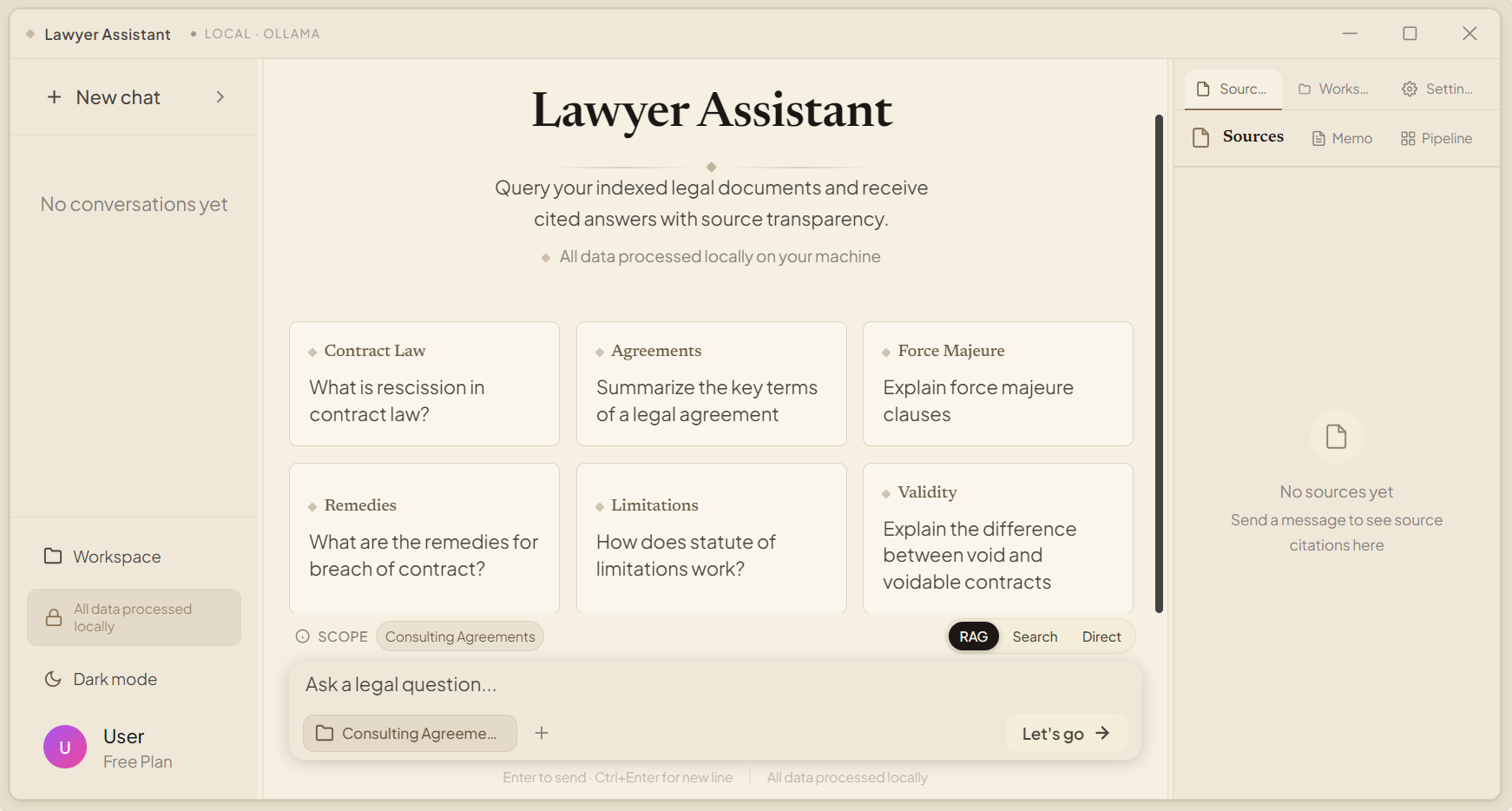
Lawyer Assistant is an AI research system that searches a law firm's own documents, verifies citations, and produces evidence-backed answers — so legal professionals spend their time on judgment, not page-turning.

Lawyer Assistant — private AI legal research app interface

The problem

  • Hours lost to searching: legal professionals spend significant time locating precedents, clauses, and facts across large collections of case files and contracts.
  • Verification burden: every answer must be traceable to a source — an unattributed claim is worthless in legal work.
  • Confidentiality: client data cannot be sent to cloud AI tools without risking privilege.

The existing workflow

  • A question arrives — from a partner, a client matter, or a review task.
  • An associate searches folders and databases by hand, then reads dozens of pages to find relevant passages.
  • Facts get extracted into notes, cross-checked, and written up with citations — slow, inconsistent, and easy to get wrong under deadline pressure.

The automated workflow

  • The lawyer asks a question in plain English.
  • The system retrieves the most relevant passages from the firm's own corpus using hybrid semantic and keyword search.
  • Every citation is verified against the source document before it reaches the answer.
  • An evidence-backed answer comes back with inline citations the lawyer can check — the lawyer, not the system, makes the call.

How it's built

  • Retrieval: BGE-M3 embeddings (ChromaDB) fused with BM25 keyword search, re-ranked for relevance.
  • Inference: local language models served via Ollama — quantized GGUF weights, no account, no cloud path, no telemetry.
  • Deployment: a desktop application for Windows, macOS, and Linux that runs entirely on hardware the firm owns.

Evaluation — measured before trusted

The system was tested against its own benchmark suite before being presented as dependable: a 200-question runner, a golden evaluation set, and CUAD-based contract tasks measuring retrieval quality and citation correctness.

Citation accuracy
96%
Search recall
94%
Data privacy
100%

Figures from the project's own evaluation suite — see backend/benchmark in the GitHub repository. Data privacy is architectural: offline mode has no cloud path.

The result

Research that used to consume an afternoon of manual reading becomes a cited answer a lawyer verifies in minutes — on hardware the firm owns, with privilege intact. The lawyer stays the decision-maker; the automation does the legwork.

Have a research workflow like this?

If your team spends hours searching and reviewing documents, tell me about it — I'll give you an honest assessment of whether it can be automated.

Describe Your Workflow